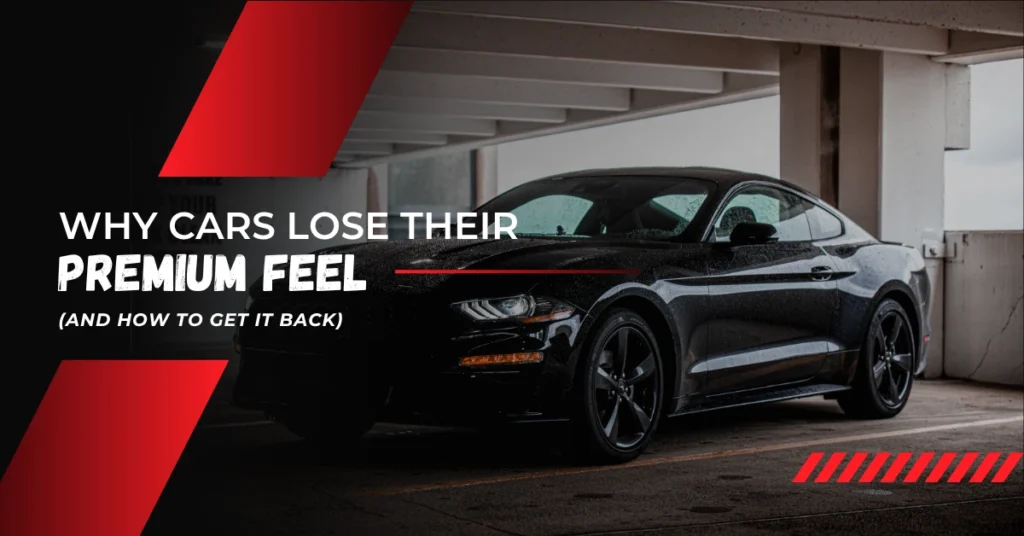
There’s a question almost every car owner ends up asking after the first few months: why do cars lose their premium feel so quickly? The car hasn’t broken down. Nothing is mechanically wrong. But somewhere between the first week and the sixth month, the experience quietly shifts from exciting to ordinary. Understanding why this happens is the first step to doing something about it.
Remember the first week? The way the door thudded shut. The new-car smell. How every drive felt like an event. That feeling was real — and so is the quiet disappointment when it starts to fade.
1. Your Brain Adapts Faster Than You Think
This is well-documented in psychology: humans adapt rapidly to new stimuli. What felt exceptional on day one becomes the new baseline within weeks. The car hasn’t changed — your brain has stopped treating it as novel. The excitement that came from novelty simply can’t be sustained indefinitely, no matter how good the product is. This isn’t unique to cars; it happens with almost every major purchase.
2. The Interior Quietly Loses Its Freshness
In the early months, the cabin smells clean. The plastics have a slight new-material texture. The seats feel fresh. Over time, dust collects in air vents and fabric textures. Odours from food, footwear, and daily use layer themselves into the upholstery. The tactile surfaces that felt premium begin to feel ordinary. None of this happens dramatically — it creeps in gradually, which is exactly why it’s easy to miss until the car feels noticeably different from when you bought it.
3. The Paint Reflection Starts to Dull
A new car’s paint has a mirror-like clarity. Over months of driving in Indian conditions, the clear coat accumulates swirl marks from washing, contamination from industrial fallout and traffic, and micro-oxidation from UV exposure. The gloss doesn’t disappear overnight — it gradually loses depth and sharpness. When you park next to another car of the same colour and notice yours looks slightly less vibrant, that’s what’s happening.
4. Small Noises and Vibrations Become Audible
Early on, owners often don’t notice minor imperfections — the emotional excitement creates a kind of positive bias. As the novelty wears off, attention shifts. That faint rattle over a speed bump, the slight vibration at highway speeds, the way the AC vent whistles slightly on high — these were always there. You’re just noticing them now. Mechanically, the car is the same. Perceptually, it feels like it’s declined.
How to Bring the Premium Feeling Back
The honest answer is that you can’t recreate first-week novelty — but you can address the genuine physical decline that layers on top of psychological adaptation.
Interior detailing removes accumulated dust, neutralises odours, conditions leather and plastic surfaces, and restores the sensory freshness of the cabin. It’s one of the most underrated services for perceived car quality.
Paint correction and ceramic coating address the optical decline. Correction removes swirl marks and surface contamination; ceramic coating then locks in the restored gloss and protects against future degradation. The car can look genuinely close to new again.
Cosmetic enhancements — replacing worn mats, refreshing trim, addressing small dings — eliminate the minor visual fatigue that accumulates over time and subtly signals “old car” to your brain.
The Bottom Line
The premium feeling fades partly in your head and partly in reality. Psychological adaptation is unavoidable — but the physical decline of paint, interior freshness, and sensory quality is not. Proper detailing and protection slow that physical decline significantly, keeping the car closer to how it felt on day one for far longer.
Frequently Asked Questions
Why does a car stop feeling premium after a few months?
Two things happen simultaneously: psychological adaptation (your brain stops treating the car as novel) and genuine physical decline (paint gloss reduces, interior freshness fades). Both are real; only the physical decline can be reversed.
Can interior detailing really restore the new-car feel?
Yes, significantly. Professional interior detailing removes bonded odours, lifts embedded dust from vents and upholstery, conditions surfaces, and restores the tactile freshness that gradually disappears with daily use.
How does ceramic coating help with the premium feel?
Ceramic coating restores and locks in paint gloss. After paint correction removes swirl marks and surface haze, ceramic coating protects that restored surface so the car holds its optical clarity for years rather than months.
How often should I get my car detailed to maintain the premium feel?
Interior detailing every 3–4 months and exterior detailing every 2–3 months is ideal for Indian driving conditions. If the car has a ceramic coating, maintenance washes extend the interval significantly.